Keyboard function keys explained: what F1–F12 actually do

This post contains affiliate links. As an Amazon Associate, I earn from qualifying purchases. This means I may earn a small commission if you purchase through my links at no extra cost to you.
Keyboard function keys explained: what F1–F12 actually do
Keyboard function keys are the top-row keys labeled F1 through F12 that perform actions instead of typing letters. Their behavior depends on the app or system, but common uses include F1 for Help, F5 for Refresh, F11 for Full Screen, and F12 for Save As or Developer Tools.
If you've ever looked at the top row of your keyboard and thought "I use maybe three of those," you're not alone. F1 through F12 sit above the number row on virtually every full-size and tenkeyless keyboard ever made, and most people hit them about as often as they read a user manual. F5 to refresh a page, maybe F11 to go full screen, and the rest collect dust for years.

There's more there than most people realize. Function keys have been part of the PC keyboard standard since the early days of computing, and while their roles have shifted, they still cut down on a lot of mouse-clicking and menu-digging if you take the time to learn them.
A bit of history: function keys first showed up on IBM terminals in the 1960s and 70s, where they were programmable keys mapped to specific software commands. Early IBM PCs actually put them on the left side of the keyboard — a layout that still appears on some specialty boards. The top-row placement came later and stuck. Apple tried replacing physical function keys with the Touch Bar on some MacBook Pros — a dynamic touchscreen strip in place of physical keys. They brought the physical keys back. Draw your own conclusions.
This guide covers what each key does by default, how major applications use them, and how to set them up for the way you actually work.
The basics of keyboard function keys
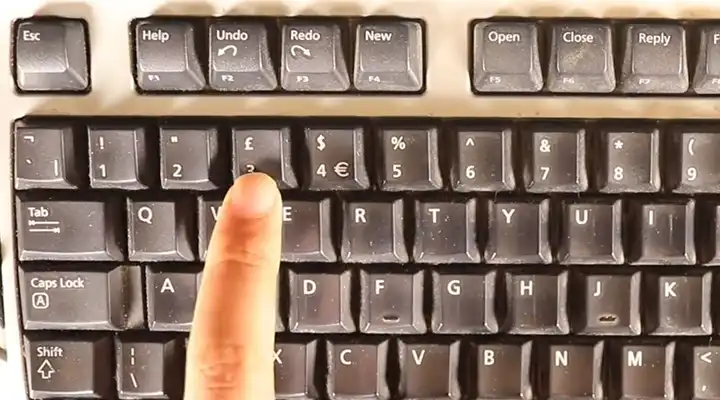
Function keys sit in the top row of most keyboards, usually separated from the number row by a small gap. Full-size and TKL boards give you all twelve. A 75% layout squeezes them in. A 65% or 60% drops them entirely — one of the real costs of going compact. If you're deciding between layouts, this keyboard size guide breaks down the tradeoffs.
What separates function keys from regular keys is that they don't produce a character. Pressing A types an A. Pressing F3 does something — or nothing — depending on the context. Their behavior is entirely software-defined.
The Fn key situation is where things get inconsistent. On desktop keyboards, F-keys work as function keys out of the box — press F5, get a refresh. On most laptops, manufacturers default to media controls instead (brightness, volume, playback). So pressing F1 might mute your audio, and you'd hold Fn to send an actual F1 signal to software. Most laptops let you flip this in BIOS or system settings. Worth doing once, then forgetting about it. If you're troubleshooting odd behavior, it can help to test your keyboard online and make sure the function row is sending the right inputs.
Windows and macOS handle function keys differently at the system level. Some behaviors in Windows have no Mac equivalent, and vice versa. Those differences get called out below.
What each function key does
F1 – Help
About as universal as keyboard shortcuts get. In almost every Windows application, F1 opens the help documentation for that program. In browsers, it opens the browser's own help page. On the Windows desktop, it pulls up Windows Help and Support.
On a Mac in media-key mode, F1 decreases screen brightness. In apps, help lives in the menu bar rather than on a key.
Not exciting, but if you're stuck in an unfamiliar program and need documentation fast, it beats hunting through the menus.
F2 – Rename and edit
On Windows, F2 renames a selected file or folder in File Explorer — no right-clicking through a context menu. Select the file, hit F2, type the new name. It's faster than it sounds when you're working through a batch of files.
In Excel and Google Sheets, F2 puts the active cell into edit mode, meaning you're editing what's already there instead of overwriting it. If you've accidentally blown away a cell's contents when you meant to add to them, F2 is what prevents that.
F3 – Find and search
F3 opens the find function in most applications. In browsers it's equivalent to Ctrl+F — the find-in-page bar. In File Explorer it jumps focus to the search bar. In word processors it cycles through search results after a search is already running.
Reaching for F3 instead of Ctrl+F is one of those small habits that sticks once you start.
F4 – Address bar and window closing
F4 on its own moves focus to the address bar in File Explorer and most browsers — good for typing a new path or URL without touching the mouse.
Alt+F4 closes the active window — most people know that one. What fewer know: Alt+F4 on the Windows desktop opens the shutdown/restart dialog.
On macOS, F4 typically opens Launchpad.
F5 – Refresh
Probably the most-used function key. F5 refreshes the page in any browser, refreshes the folder view in File Explorer, and starts a PowerPoint slideshow from the beginning. Shift+F5 starts from the current slide, which is more useful when you're already mid-presentation.
For web development: Ctrl+F5 or Ctrl+Shift+R does a hard refresh that bypasses the cache. Regular F5 may still pull from cached assets.
F6 – Navigation between elements
F6 moves focus between interface elements. In browsers it jumps to the address bar. In Office apps it cycles between panes and panels.
It's less consistent than other F-keys, but in browsers it's worth knowing for keyboard-first navigation.
F7 – Spell check and caret browsing
In Word and most Office apps, F7 opens spell check. That hasn't changed in decades.
In browsers, F7 toggles caret browsing — a mode that places a movable text cursor on web pages so you can navigate and select without a mouse. Almost nobody turns this on intentionally. It's mainly famous for startling people who hit F7 by accident in Firefox or Chrome and couldn't figure out why there was suddenly a blinking cursor on the page.
F8 – Safe mode and extended selection
F8 has a narrow job, but it matters in specific situations.
On Windows versions before Windows 8, pressing F8 at startup brought up Safe Mode and the advanced boot menu. Windows 10 and 11 route that differently now, but on older systems F8 at boot still works.
In Word, F8 activates extended selection mode — you can expand a selection with arrow keys without holding Shift. Niche, but it's there.
F9 – Field refresh and email
In Word, F9 refreshes document fields: date stamps, table of contents entries, cross-references. If your TOC is showing wrong page numbers, F9 fixes it.
In Outlook, F9 triggers Send/Receive immediately.
F9 is one of the least standardized keys at the OS level. Logic Pro uses it for a transport control. Most applications treat it as available real estate and assign it to whatever makes sense.
F10 – Menu bar access
F10 activates the menu bar in Windows applications — keyboard-only access to File, Edit, View, and whatever else is up there. Arrow keys and Enter to navigate from there. It predates widespread mouse use and still works exactly the same way.
Shift+F10 opens the right-click context menu for whatever's selected. If you're already working from the keyboard, this is faster than reaching for the mouse just to right-click.
F11 – Full screen
F11 toggles full-screen mode in browsers on Windows. Chrome, Firefox, and Edge all respond to it. Everything above the page — tabs, address bar, buttons — disappears. Press F11 again to come back.
On macOS, F11 moves all windows aside to show the desktop. Full-screen in Mac browsers works through the green window button instead.
F12 – Save As and developer tools
F12 does completely different things depending on where you are.
In Word, Excel, and PowerPoint, it opens Save As. Faster than going through File > Save As when you want to save a copy somewhere else or under a different name.
In browsers, F12 opens developer tools — the panel for inspecting HTML, CSS, JavaScript, and network requests. If you've ever accidentally hit F12 in Chrome and had a panel full of code appear along the bottom of your screen, that's what it was. For web developers, this is probably the most-used function key on the board.
Function keys in popular software
Microsoft Office
Word maps something to nearly every function key. F1 help, F2 move text, F4 repeat last action, F5 Go To dialog, F6 switch panes, F7 spelling, F8 extend selection, F9 update fields, F10 menu bar, F11 next field, F12 Save As. Add Shift, Ctrl, and Alt and things branch further. Microsoft publishes the full list — worth having open if you work in Word seriously.
In Excel, three keys carry most of the weight. F2 edits the current cell. F9 recalculates the workbook. F4 toggles formula references between $A$1, A$1, $A1, and A1 — cycling absolute and relative references. That last one sounds minor until you've manually edited a dozen formula references and then found out F4 would have done it in a keystroke.
Web browsers
Outside of F5, F11, F12, and F3/Ctrl+F, browsers don't use the function row much. Most browser shortcuts lean on Ctrl and Alt combos. If you want to see how the row fits into different board formats, the keyboard size guide is a useful reference.
Inside DevTools, though, F-keys take on a second life: F8 pauses JavaScript execution, F10 steps over a line of code, F11 steps into a function call. If you do front-end debugging, those three become automatic.
Gaming
F-keys in games vary by title: squad commands in strategy games, quick-save in RPGs (F5 is a classic), scoreboard toggles. Most games let you rebind them.
On programmable keyboards, F-keys are also good candidates for macros. A key that does nothing for your normal workflow can become a launch shortcut, a DPI toggle, or a multi-step macro through companion software. If you like this kind of flexibility, a hot-swappable keyboard can make experimenting with different switches even easier.
Creative software
Photoshop assigns F5 (Brushes), F6 (Color), F7 (Layers), F8 (Info), and F12 (revert to last saved) by default. If you're in Photoshop all day, those panel shortcuts start saving real time.
Premiere Pro and DaVinci Resolve also use the function row heavily — playback controls, trim functions, panel navigation. Creative applications tend to treat the full keyboard as available real estate, because the people using them are trying to keep their hands off the mouse as much as possible.
How to customize and reassign function keys
OS-level settings
On Windows, for laptops that default F-keys to media controls, look in BIOS/UEFI or in the manufacturer's utility — Lenovo Vantage, HP Command Center, whatever shipped with your machine. Some keyboards have a dedicated Fn Lock key that toggles the behavior.
On macOS: System Settings > Keyboard > Keyboard Shortcuts. You can flip function key behavior globally or let specific apps override it. Takes about two minutes to set up and saves ongoing friction.
Keyboard software
Most gaming and enthusiast keyboards come with per-key remapping software: Corsair iCUE, Razer Synapse, SteelSeries GG. Any F-key can become a different keystroke, a macro, a media command, or a launch shortcut.
QMK and VIA go further — open-source firmware that supports multiple keyboard layers. Different F-key assignments on different layers, switchable on the fly. If your board runs QMK, the function row is fully yours.
Application shortcuts
Many apps let you set shortcuts independently of the OS or keyboard software. Adobe Photoshop: Edit > Keyboard Shortcuts. Premiere Pro has its own shortcuts panel. Office lets you assign macros to F-keys through the macro editor.
Application-level changes follow the software, not the hardware. Same shortcuts wherever the app is installed.
Finding what works
Before remapping anything, figure out what you actually use. Spend a week being deliberate about pressing F-keys instead of going for the mouse or Ctrl shortcuts. Make a mental note — or an actual one — of which ones save time and which you never reach for. Then check what your most-used apps assign to the keys you're ignoring and decide if a remap makes sense.
Writers: F5 (Go To), F7 (spell check), and F12 (Save As) in Office are worth knowing without thinking. Developers: F12 in the browser and the DevTools debugger shortcuts. Gamers: a programmable board with decent software opens up a lot.
You don't have to use all twelve. Six you actually use beats twelve you theoretically have access to.
Conclusion
Function keys have been on keyboards since before most of us were using computers. They're not what comes up in conversations about switches or keycaps or how a board sounds. But they're on every full-size and TKL you'll ever own, and knowing them makes you faster.
F12 means something different in Word than in Chrome than in a QMK layer. They're not one-size-fits-all — they're context-specific, and that context is what makes them actually worth learning.
Find the three or four that apply to what you do. Use them deliberately for a week. Once those stick, add more. If you have a board that supports remapping, spend an hour on it. The time comes back fast.

![[Solved] Onn Keyboard Not Working](https://keyboardhunter.com/wp-content/uploads/2023/10/Onn-Keyboard-Not-Working-768x431.webp)